No SEO Brief Before Writing Content? You’re Wasting Time
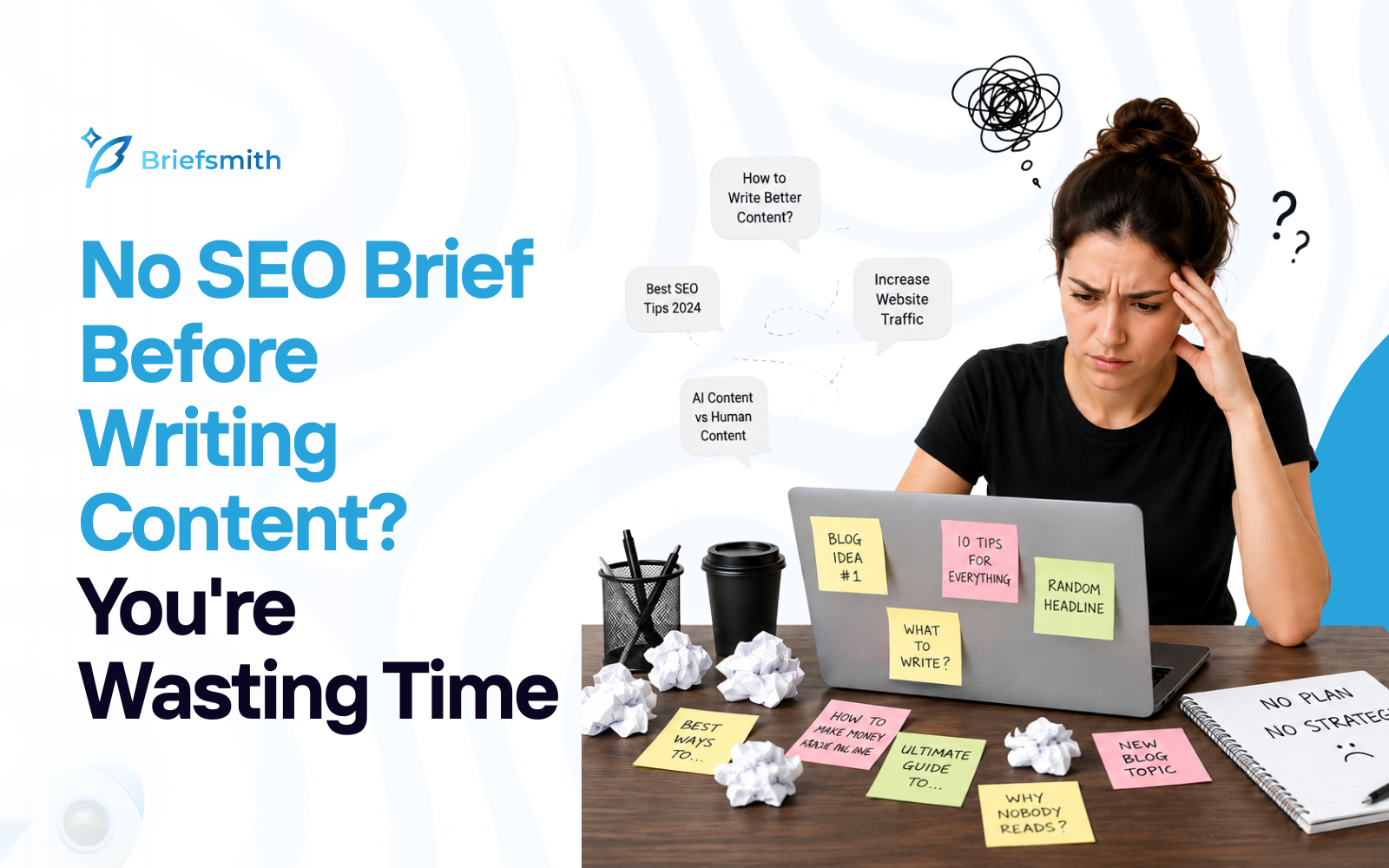
You sat down, opened a blank doc, and started writing. You poured hours into an article you were genuinely proud of. You published it. And then… nothing.
No rankings. No traffic. No leads.
Here’s the hard truth most content courses won’t tell you: the article was dead before you typed the first word. Not because your writing was bad, but because you skipped the most important step in the entire content process.
Creating a proper SEO brief before writing Content is what separates Content that ranks on page one from Content that disappears into the void. It’s not optional. It’s not a formality. It’s the foundation on which everything else is built.
This guide will show you exactly what you’re losing by skipping it, how to build one that actually works, and how Briefsmith makes the whole process faster and smarter than doing it manually.
What Is an SEO Brief (and Why Does It Exist)?
Quick Answer: An SEO brief is a structured planning document created before any writing begins. It defines the target keyword, search intent, content structure, competitor gaps, and on-page optimization requirements, so the final article is built to rank from the ground up rather than patched together after the fact.
Think of it as the architectural blueprint for your Content. A builder doesn’t start laying bricks without a plan. A content team shouldn’t start writing without a brief.
Understanding the importance of the content brief to SEO practitioners comes down to one core insight: Google doesn’t rank articles; it ranks relevance. An SEO brief ensures your Content is relevant to the right query, at the right depth, for the right audience, before a single paragraph is written.
The Real Cost of Skipping the Brief
Most businesses underestimate the cost of publishing without a brief. Let’s put real numbers to it.
Time wasted per article:
- Average time to write a 1,500-word post without a brief: 6–10 hours
- Average time spent on rewrites and post-publish SEO fixes: 3–5 additional hours
- Total lost time per article: up to 15 hours
Multiply that across a content team publishing 8 articles a month, and you’re burning 120 hours of productive work every single month on Content that was never set up to succeed.
Beyond time, there’s the opportunity cost. Every article you publish without a proper brief is a missed ranking opportunity. A spot on page one that a competitor is claiming instead of you.
Why Content Without an SEO Brief Rarely Ranks
It Targets the Wrong Keywords
Without a brief, most writers default to writing about what feels relevant rather than what users are actually searching for. The result: Content that’s topically close but keyword-misaligned, and Google knows the difference.
It Misses Search Intent
There are four types of search intent: informational, navigational, commercial, and transactional. Google’s algorithm is remarkably good at understanding which type of query a query signals. If your Content has the wrong intent, even with the right keyword, it won’t rank consistently.
It Lacks Structural Signals
Google reads your heading hierarchy (H1, H2, H3) to understand what your Content covers and how comprehensively it covers it. Without a planned structure, most articles end up with inconsistent headings, skipped semantic topics, and gaps that competing articles don’t have.
It Has No Competitor Awareness
The pages currently ranking for your target keyword are ranking for a reason. Without a brief that includes competitor analysis, your article has no way to address the gaps they leave open, the very gaps that give you a chance to rank above them.
It Produces Thin or Overlapping Content
Without intentional content planning before publishing, teams frequently create articles that cannibalize each other and multiple posts targeting the same keyword, none of which are strong enough to win.
What a High-Impact SEO Brief Actually Contains
This is where most guides stop at the surface. Here’s what a genuinely useful SEO brief looks like in practice:
| SEO Brief Element | What It Does |
|---|---|
| Primary keyword | Defines the exact ranking target |
| Secondary & semantic keywords | Fills out topical depth and NLP signals |
| Search intent classification | Ensures the content format matches user expectation |
| Target word count | Calibrates depth against top-ranking competitors |
| H1 / H2 / H3 outline | Creates a structured, crawlable content hierarchy |
| Competitor gap analysis | Identifies topics the current top results miss |
| Internal linking plan | Builds topical authority before publishing |
| Meta title + description | Sets up CTR optimization from the start |
| Featured snippet target | Identifies answer-box opportunities |
| CTA / conversion goal | Connects the content to a business outcome |
A brief that includes all ten of these elements is a brief that produces content with a genuine shot at ranking. Anything less is guesswork.
How to Create an SEO Brief That Actually Works
Knowing how to create SEO brief documents that perform takes a combination of research tools, competitive awareness, and content strategy experience. Here’s the process:
Step 1: Start With Keyword Research
Don’t pick a keyword because it sounds right. Use data. Look for keywords with:
- Meaningful search volume (at least 100–1,000 monthly searches, depending on your niche)
- Manageable keyword difficulty for your domain authority
- High commercial or informational intent aligned with your business goal
Tools like Ahrefs, Semrush, or Briefsmith’s built-in keyword discovery tools automatically surface these opportunities.
Step 2: Analyze the Top 5 Ranking Results
For your target keyword, open the top five ranking pages and ask:
- What headings do they all share? (These are the non-negotiable topics to cover.)
- What questions do they leave unanswered? (These are your ranking opportunities.)
- What’s their average word count? (Your Content should match or exceed it.)
- What formats do they use: lists, tables, or steps? (Match the format to match the intent.)
Step 3: Define the Exact Search Intent
Classify the query: Is the user looking for information, a how-to guide, a product comparison, or a specific page? Your content format must match. A transactional query needs a strong CTA and product focus. An informational query needs depth and definitions.
Step 4: Build the Content Outline
Map out your H1s, H2s, and H3s before writing a word. Include:
- The primary keyword in the H1
- Secondary keywords are distributed naturally across H2s
- At least one FAQ section targeting long-tail question keywords
Step 5: Plan Internal Links Before You Write
Internal linking is most effective when it’s strategic, not accidental. Identifying which existing pages you can link from and to before writing it shapes your anchor text choices and ensures your new Content integrates cleanly into your site’s topical architecture.
Step 6: Set the Conversion Goal
Every piece of Content should have a purpose beyond rankings. Define it upfront: Is the goal to drive free-trial signups? A demo request? An email opt-in? Build the CTA into the brief so it shapes the Content’s direction from the start.
How Briefsmith Automates the SEO Brief Process
Building a thorough SEO brief manually takes 2–4 hours per article. For a team publishing 8+ articles a month, that’s a significant time investment and a significant source of inconsistency when briefs get rushed or skipped.
This is exactly what the Briefsmith content workflow was built to solve.
Briefsmith is an end-to-end content platform that automatically generates complete, data-driven SEO briefs, pulling in keyword data, competitor analysis, search intent signals, and content structure recommendations in minutes, not hours.
Here’s what Briefsmith does in the briefing phase:
- Keyword Discovery: Surfaces high-opportunity primary and semantic keywords ranked by volume, difficulty, and business relevance
- Intent Analysis: Automatically classifies search intent and recommends the right content format
- Competitor Gap Mapping: Scans the top-ranking pages and identifies the topics they miss
- Auto-Generated Outline: Produces a full H1/H2/H3 content structure based on real ranking data
- Internal Link Suggestions: Recommends existing pages to link to and from, based on topical relevance
- Meta Title + Description Generator: Produces click-optimized metadata aligned with keyword targets
The result: a complete, publish-ready content brief in the time it used to take to do the keyword research.
Briefsmith as Your SEO Writing Planning Tool
What makes Briefsmith different from standalone SEO tools like Ahrefs or Semrush is that it doesn’t stop at the data. It bridges the gap between research and execution, making it a true SEO writing planning tool rather than just an analytics dashboard.
With Briefsmith, your content team follows a consistent, repeatable process every single time:
- Enter your topic or keyword: Briefsmith pulls keyword data and intent signals immediately
- Review the auto-generated brief: Full outline, word count target, competitor gaps, and semantic keywords
- Write inside the optimized framework: The brief guides every section as you write
- Run pre-publish SEO check: Score your Content against top competitors before it goes live
- Publish and repurpose: Push to WordPress and convert the article into social, email, and short-form Content
No more publishing and praying. Every article starts with a brief. Every brief is built on data. Every piece of Content is set up to rank.
Common Mistakes Teams Make With SEO Briefs
Even teams that do create briefs often make these critical errors:
Mistake 1: Using a Generic Template
A brief template downloaded from a blog is not the same as a data-driven brief built around actual SERP analysis. Generic templates miss competitor-specific insights and real keyword data.
Mistake 2: Writing the Brief After the Article
Some writers draft the article first, then create the brief retroactively. This completely defeats the purpose of retrofitting a structure onto Content that was never built for rankings.
Mistake 3: Ignoring Semantic Keywords
Targeting only the primary keyword and ignoring related terms leaves significant NLP and topical authority signals on the table. Google expects to see a cluster of semantically related terms, not just one repeated phrase.
Mistake 4: No Content Refresh Plan
A brief is for new Content, but your existing Content needs briefs for updates, too. Pages ranking in positions 6–20 are often one targeted refresh away from a major jump.
Mistake 5: Disconnecting the Brief from the CTA
If the brief doesn’t define the conversion goal, the writer has no anchor. Content that’s well-optimized for search but poorly optimized for conversion is only doing half the job.
Expert Tips for Briefs That Drive Real Results
Tip 1: Match content depth to SERP intent, not your word count preference. If the top-ranking articles for your keyword average 2,200 words, publishing 800 words won’t cut it, even if your 800 words are brilliant.
Tip 2: Always include a featured snippet target in your brief. Identify the question your article can answer in 40–60 words and structure a response block in your Content specifically designed to capture the answer box.
Tip 3: Build topical clusters around your briefs. Each brief you create should fit into a broader topic cluster, a pillar page with supporting articles. Briefsmith makes this cluster planning visual and actionable.
Tip 4: Assign briefs as a team checkpoint. In agency and content team settings, the brief should be reviewed and approved before writing begins. No brief approval = no writing starts. This one rule alone can eliminate most post-publish revisions.
Tip 5: Use the brief to manage scope creep. Without a defined outline, writers tend to over-cover some topics and under-cover others. The brief is the scope document. Stick to it.
Frequently Asked Questions
What is an SEO brief before writing Content?
An SEO brief before writing Content is a structured planning document that defines the target keyword, search intent, heading structure, competitor gaps, word count, internal links, and conversion goal before any writing begins. It ensures every article is built to rank from the ground up rather than optimized as an afterthought.
Why is the importance of a content brief in SEO so significant?
Content briefs are critical in SEO because they align your Content with exactly what Google needs to rank it: the right keyword, the right intent match, the right topical depth, and the right structure. Without a brief, writers produce Content based on instinct rather than data, and instinct rarely beats a well-researched competitor.
How long does it take to create an SEO brief?
Creating a thorough SEO brief manually takes 2–4 hours when done properly. Using a platform like Briefsmith, the same brief, including keyword data, competitor analysis, outline, and meta fields, is generated in minutes, allowing teams to brief more Content with greater consistency.
What should a content brief include for SEO?
A strong SEO content brief should include: primary keyword, secondary and semantic keywords, search intent classification, target word count, H1/H2/H3 outline, competitor gap analysis, internal linking plan, meta title and description, featured snippet target, and a defined CTA or conversion goal.
Can I use Briefsmith to automatically create SEO briefs?
Yes. Briefsmith’s content workflow automatically generates complete, data-driven SEO briefs, including keyword research, intent analysis, competitor gap mapping, auto-generated outlines, and meta recommendations. It’s built specifically for business owners, marketers, agencies, and content teams who need to produce optimized Content at scale without spending hours on manual research.
Is content planning before publishing really necessary for small blogs?
Absolutely. In fact, content planning before publishing matters even more for smaller blogs and new domains because you have less domain authority to fall back on. A well-briefed, tightly optimized article on a low-authority site will almost always outrank a poorly briefed article on a stronger domain, given equal competition.
How does an SEO brief improve content team efficiency?
An SEO brief removes ambiguity for every writer on your team. Instead of each person interpreting a topic differently, a brief creates a shared, data-backed framework. The result: fewer revisions, less time in editing, more consistent quality, and Content that’s optimized before it goes to the first draft, not after it’s already published.
Start Every Article With a Brief. Start Every Brief With Briefsmith.
The single most impactful change most content teams can make isn’t writing better, it’s planning smarter. A properly built SEO brief before writing Content doesn’t just improve your rankings. It improves your entire workflow: less wasted time, fewer rewrites, more consistent quality, and Content that starts earning traffic from the day it goes live.
Briefsmith is the platform built to make this your default process, not a once-in-a-while best practice, but the standard way your team operates every time a new article begins.
👉 Try Briefsmith free today and create your first data-driven SEO brief in minutes, not hours.