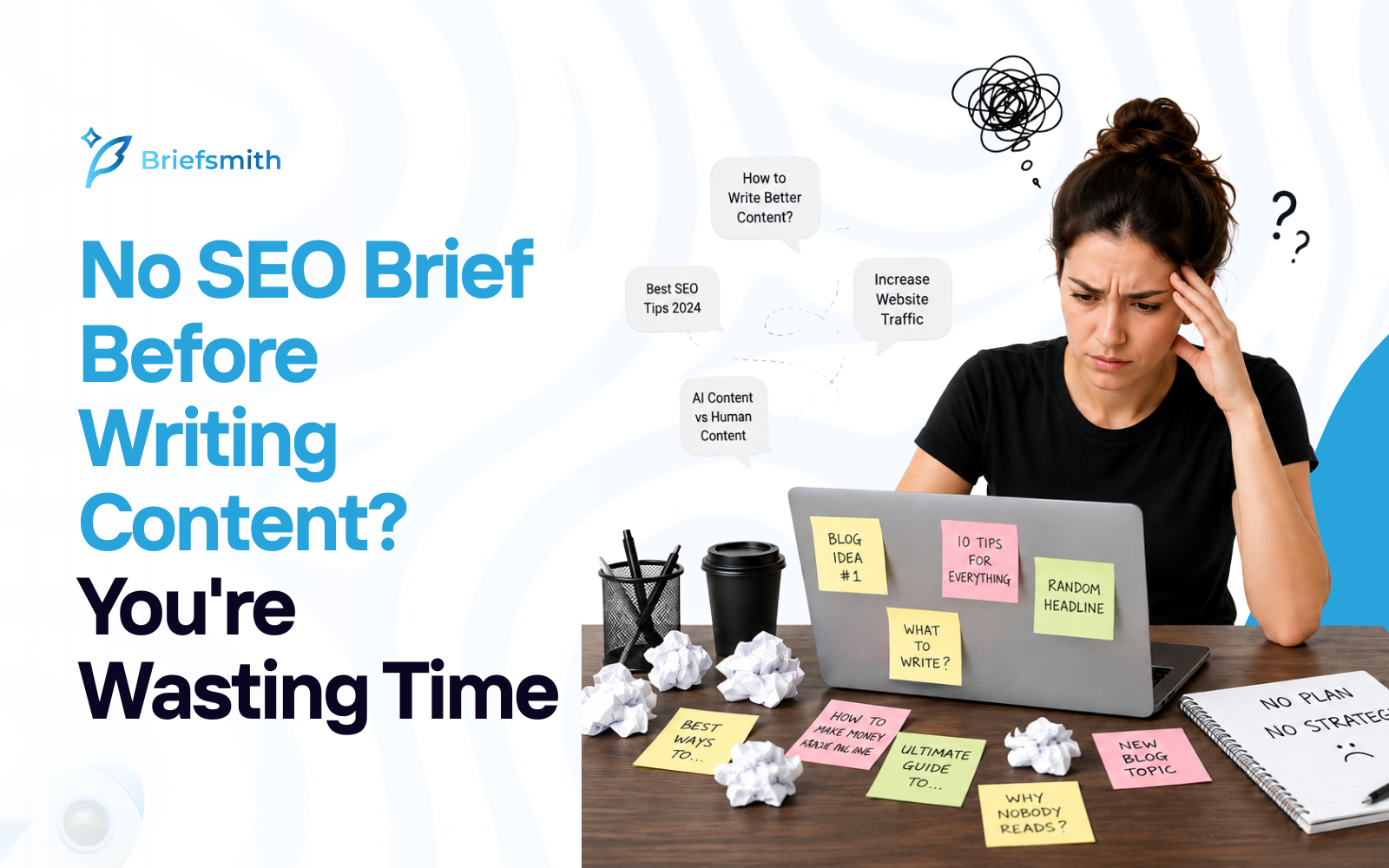
Smarter AI Content Workflow: How Top Brands Win in 2026

A smarter AI content workflow is a structured system that turns AI from a fast typing tool into a reliable content engine. Instead of prompting a chatbot and hoping for the best, top brands feed AI a clear content brief, brand rules, and search intent data first. The result is content that ranks, builds trust, and drives leads, not the generic filler most teams publish.
If your AI content gets ignored by Google and readers alike, the tool isn’t broken. Your workflow is. This guide shows you exactly how the best teams fixed theirs, and how you can copy the system in 2026.
Quick answer: The smarter AI content workflow follows five stages, research and intent, content brief, brand-safe AI drafting, human editing, and publishing with optimization. Skipping the brief stage is the single biggest reason AI content fails.
The Real Problem: Why Most AI Content Fails
Most teams adopted AI the wrong way. They opened a blank chatbot, typed “write a blog post about X,” and pasted the output straight onto their site. It felt fast. It felt productive.
Then nothing happened. No rankings. No shares. No leads.
Here is what actually goes wrong:
- Generic output. AI writes the average of everything it has read. Without direction, it produces safe, forgettable content that sounds like every other blog.
- No search intent. The article answers a question nobody is searching, or answers it in the wrong format.
- Off-brand voice. The tone clashes with your brand, and legal or factual mistakes slip through.
- Thin coverage. AI fills space without depth, and Google’s helpful content systems quietly bury it.
The lesson is simple. AI is a powerful writer, but a terrible strategist. When you ask it to do both jobs at once, quality collapses. To avoid generic AI blog content, you have to separate strategy from writing.
Root Cause: Strategy and Writing Are Two Different Jobs
Imagine hiring a brilliant writer and giving them zero instructions, no topic, no audience, no goal. You would never expect great results. Yet that is exactly how most people use AI.
The root cause of failure is missing structure before generation. A great human writer still needs a brief. AI needs one even more, because it cannot read your mind, your market, or your customer.
This is why structured AI content creation outperforms freestyle prompting every time. When you define the topic, keywords, intent, angle, and structure upfront, AI stops guessing and starts executing. The same model that produced bland copy yesterday produces sharp, rankable content today, simply because the inputs changed.
We see this pattern constantly at Briefsmith. Teams blame the AI when the real gap is the content brief before AI writing.
The Smarter AI Content Workflow: 5 Steps
Here is the exact workflow top brands use in 2026. Follow it in order.
Step 1: Research and Search Intent
Before anything is written, understand what searchers actually want. Identify the primary keyword, the questions people ask, and the content format Google already rewards for that query.
Ask: Is the intent informational, commercial, or transactional? Match your content type to the answer.
Step 2: Build a Content Brief
This is the stage almost everyone skips, and it is the most important. A strong brief defines:
- Target keyword and semantic terms
- Search intent and audience
- Recommended structure (H2s, H3s, FAQs)
- Word count and tone
- Internal links and key facts to include
A solid content brief before AI writing is what separates content that ranks from content that disappears. It is the difference between a strategy and a guess.
Step 3: Brand-Safe AI Drafting
Now you let AI write, but inside guardrails. Feed it the brief, your brand voice, and any non-negotiable facts. This is brand-safe AI writing: the AI moves fast, but it stays on-message, on-brand, and factually grounded.
Step 4: Human Editing and EEAT
A human editor adds what AI cannot: first-hand experience, original examples, expert nuance, and genuine point of view. This step injects the experience and expertise that Google’s EEAT framework rewards and that readers trust.
Step 5: Optimize and Publish
Finalize on-page SEO, add schema, set internal links, and publish. Then track performance and update underperformers, because content is a living asset, not a one-time task.
| Workflow Stage | Who Leads | Main Goal |
|---|---|---|
| 1. Research & Intent | Strategist | Understand the searcher |
| 2. Content Brief | Strategist / Tool | Give AI direction |
| 3. AI Drafting | AI | Produce a fast first draft |
| 4. Human Editing | Editor | Add trust, voice, EEAT |
| 5. Optimize & Publish | SEO / Editor | Rank and convert |
Case Study: From Invisible to Ranking
Consider a typical mid-size B2B team we worked with through Briefsmith. They were publishing twelve AI-written posts a month and getting almost no organic traffic. The volume looked impressive. The results were zero.
We changed one thing: they stopped freestyle prompting and adopted a brief-first workflow. Every article started with a structured content brief, was drafted inside brand guardrails, then edited by a human for experience and voice.
Within three months, output dropped to eight posts a month, but organic traffic climbed steadily, and several articles started appearing in Google’s AI Overviews. The takeaway is clear: fewer, structured articles beat high-volume generic content every time.
This mirrors a wider industry shift. As AI writing became cheap and universal, generic content lost all value. Differentiation now comes from strategy, structure, and genuine expertise, exactly what a smarter AI content strategy platform is built to deliver.
Common Mistakes to Avoid
Even teams with good intentions trip over these:
- Prompting without a brief. The number one cause of generic output.
- Publishing AI drafts unedited. No human voice means no trust and no EEAT.
- Ignoring search intent. Beautiful content that answers the wrong question still fails.
- Chasing volume over quality. Twenty thin posts lose to three strong ones.
- No brand guardrails. Off-brand, inaccurate, or risky claims slip through.
- Set-and-forget. Never updating content lets rankings decay over time.
Expert Tips for 2026
A few hard-won insights from working with content teams:
- Treat the brief as the product. If the brief is excellent, the article almost writes itself.
- Write for both humans and AI engines. Use clear definitions, structured answers, and entity-rich language so ChatGPT, Gemini, Perplexity, and Google AI Overviews can cite you.
- Lead with the answer. Put the direct answer in the first 40 to 60 words of every section. This wins featured snippets and AI citations.
- Keep a human in the loop, always. AI handles speed. Humans handle trust.
- Standardize your workflow. A repeatable system beats individual talent at scale.
Frequently Asked Questions
What is a smarter AI content workflow?
A smarter AI content workflow is a structured process that guides AI with research, a content brief, and brand rules before writing. It produces content that ranks and converts, instead of the generic output you get from freestyle prompting.
How do I avoid generic AI blog content?
Stop prompting a blank chatbot. Give AI a detailed content brief with the target keyword, search intent, structure, and brand voice. Direction is what removes the “average internet” tone from AI writing.
Why do I need a content brief before AI writing?
A content brief before AI writing tells the model exactly what to produce, the topic, keywords, intent, structure, and facts. Without it, AI guesses, and guessing produces forgettable content that does not rank.
What does brand-safe AI writing mean?
Brand-safe AI writing means the AI drafts inside guardrails: your tone, your messaging, and verified facts. This keeps content consistent, accurate, and free of off-brand or risky claims.
Does Google penalize AI content?
No. Google does not penalize AI content by default. It rewards helpful, people-first content and buries thin, generic content, regardless of how it was made. Structure, intent, and EEAT decide rankings.
What is an AI content strategy platform?
An AI content strategy platform combines research, briefs, brand-safe drafting, and optimization in one connected workflow, so teams move from idea to published, rankable article without disconnected tools.
Conclusion: Build the Workflow, Win the Search
The brands winning in 2026 are not the ones using the most AI. They are the ones using a smarter AI content workflow, a structured system where strategy comes first and AI executes inside clear guardrails.
The formula is repeatable: research the intent, build the brief, draft brand-safe, edit for trust, then optimize and publish. Do this consistently and you will stop publishing content that disappears and start publishing content that ranks, gets cited by AI engines, and generates leads.
Ready to stop guessing? Briefsmith turns this entire workflow into one connected flow, from content brief to publish-ready article. Start building smarter content with Briefsmith today.